
AI-native lawyers? Yet another test for the power of inertia
How lawyers can deal with the consequences of accepting AI as ubiquitous, commoditized infrastructure
(You are reading a GenAI-free article, solely relying on auto-correct for some expressions and typos.)
(Edited on January 29th 2026 to reflect recent studies and improve the overall flow.)
AI has been impacting legal services at many different levels for a few years now. Much has been written about the new possibilities in a market that seems the ideal target for disruption at the hands of language-based models (we published our own paper on the subject last year - and much of it is probably obsolete at this point).
Trying to keep this succinct, I believe there are two important dynamics at play. They may very well define the future of the legal profession - and, in the short term, the real meaning of an “AI-native” law firm.
The first one concerns the speed at which AI floods the software layer to become infrastructure, or a liquid commodity that renders “productization” obsolete.
The second one relates to the evolving capabilities of AI in terms of producing a solid legal output (contracts, advice, risk-assessment, etc.).
In other words, the parallel evolution of both flavors of language automation (code, law), naturally intertwined, will have a seismic impact on what we now call the practice of law.
Language as Code: plastic bottles vs. running water
I really like how Jamie Tso put it recently in the context of differentiated cultural perspectives: Asian entrepreneurs are treating AI as “infrastructure”. Under this paradigm, software will quickly become the mere temporary output of an ever-present superintelligence layer (my take).
Meanwhile, US and European technology-based innovation has matured around cloud-based, Software as a Service solutions. These have been entrenched through a specific approach to venture capital, business models, and even founder or employee incentives. A very dynamic set of layered stacks has helped hundreds of thousands of vendors flourish. The LegalTech vertical has been no exception.
It is only logical that AI or “agentic” capabilities are perceived by most of us as an add-on that supercharges existing solutions with ever-smarter features and workflow automation - rather than bespoke, on-demand components and interfaces, ephemeral or persistent, entirely owned by the teams who can best articulate their needs. The same is true of our perception of AI as inherently cloud-dependent, or the apparent inevitability of frontier labs as pipeline providers.
The application of such prevailing mindset to the manner in which Big Law approaches innovation throws few surprises. AI “products” have been integrated into the technologies they now use. Thomson Reuters extends its widely popular suit with CoCounsel. Legora and Harvey sit on top of Microsoft Word, of all places.
Interestingly, however, a recent study conducted by Singapore-based LegalBenchmarks.ai has shown that big-budget, legal-specific “GPT wrappers” fall considerably behind general purpose LLMs in the automation of contract drafting tasks (with one such tool ranking last in “usefulness” and only mid-pack in “reliability”).
Vibe lawyering
The other side of the equation is the actual ability of the new layer to gradually replace the bulk of what we call legal work, beyond the automation of the underlying workflow. However slowly this happens, the value of generative AI is sufficiently proven to call into question the “billable hour” as a business model.
This realization has provoked an advent of new “law firms”. Some of them (e.g., Crosby) limit their scope to contract reviews and other highly-scalable tasks. AI allows for quick turnaround commitments (despite ensuring an attorney-in-the-loop) and an optimization cycle that builds competitive advantages over time.
Still, I believe that this first iteration of AI-powered legal services does not take into account the manner in which customers work with AI tools in 2026. Why offer an NDA or DPA when every startup can simply ask Claude Code or a local deployment of Olmo 3 to generate one? What prevents an even better adapted kind of law firm from switching from decades-old templates to proprietary “AI Skills” that maintain flexibilities and composability while embedding best practices and a certain tone or signature style?
Should models keep improving on this particular front, it is very likely that we end up talking about “vibe lawyering” rather than vibe coding (to borrow a term recently used by the Law://WhatsNext hosts, Tom Rice and Alex Herrity). Luckily it is at that point that the profession’s important moat really kicks in: going through law school, passing the bar, joining a professional body that ensures basic ethical standards, paying for insurance… it would appear that those will become even more important as the lawyer’s role is reduced to judgement in the absence of solid context - at least until the current court system is replaced by AI-native dispute resolution and self-enforcement tools.
The truly AI-native law firm
With all that said, I find it rather naive to expect 100% of AI-derived efficiencies to accrue on one side of the market (providers) in the face of a tide that lifts all boats.
It is obvious that in-house teams can leverage the very same tools to speed up contract reviews, drafting, due diligence, or M&A negotiations. But this alone does not result in a paradigm shift: it is the notion of AI as a utility, available on demand across the board. Accepting the ruthless commoditization of the newly discovered “augmentation”.
In summary, for all the claims of an “AI-native lawfirm” (expect these to literally explode), I find it misleading to apply it to a team that simply leverages AI to do the exact same thing: automate a decades-old workflow, stick to the same value proposition.
The term should be reserved instead, I believe, for those who assume that everybody else is using AI too - and define their services accordingly. This requires much more serious reinvention, from questioning the logic of document exchanges to challenging previous perceptions of subject-matter expertise… to daring dumping Microsoft Word for good.
With all of the above in mind, this is how I see the current interplay between AI and the practice of law:
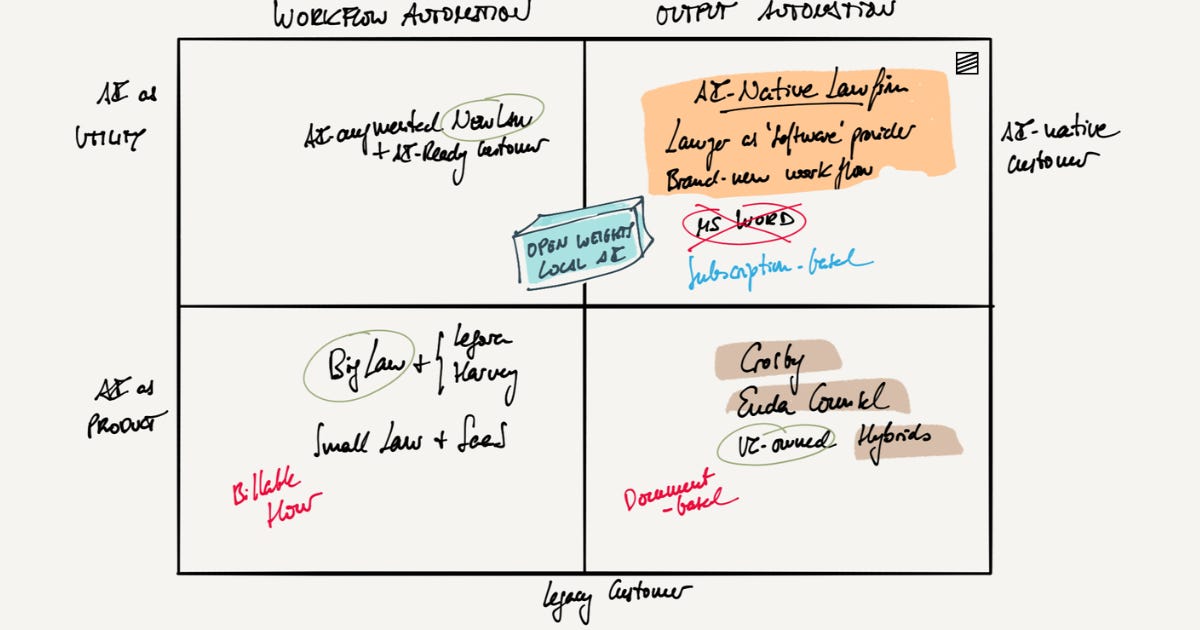
Explaining this chart (I hope it becomes neater over time):
We are looking at disruption on both sides of the market, demand and supply: law firms can be stuck in legacy business models or embrace a value-based model. Customers can also be stuck in their own legacy paradigm (through their expectations and AI capabilities) or join a new world of shared possibilities.
BOTTOM LEFT QUADRANT (Legacy law firms + SaaS-minded Legal AI)
Legal AI firms like Legora and Harvey are sitting on top of legacy systems and a legacy business model, which is probably the smartest strategy for a “software” company in the old sense of the word (the only one we have known so far and possibly the only one that VC investors can fit in their own models!). They sell subscriptions to those that would love to perpetuate the “billable hour” model.
TOP LEFT QUADRANT (AI-augmented NewLaw firms)
So-called NewLaw firms are already born out of updated customer expectations. Many have embraced agentic-powered workflows to introduce serious efficiencies in terms of speed and individual throughput. Still, these new capabilities seem to have been born in isolation - oblivious to the level of independence recently gained by AI-native customers.
BOTTOM RIGHT QUADRANT (product and services are married, but not blended)
Even though they do not seem to be ready to break away from the older game (as they still sell software to others), VC-funded Eudia Counsel and Crosby AI have set up AI-augmented law firms -both of them through Arizona-based special vehicles that allow for private ownership of the regulated offering.
(I have left template/boilerplate-based vendors and pre-LLM AI solutions out of the picture altogether. Appreciating their current customer base and brands as important moats, I doubt they can have an impact on the future of the profession.)
And the winner is?
I would argue that the top right quadrant is reserved for teams subscribing to the new paradigm (truly “AI-native lawyers”), which basically means meeting three conditions:
They serve AI-native customers: a new breed of companies born free of legacy workflows, email attachments, document version control… Microsoft Word (I cannot wait for this one)
They do not depend on “software providers” but rather are software-powered by simply sitting on top of an AI layer that happens to spit out software on demand, rendering at-scale offerings and the SaaS model entirely obsolete. This requires an unprecedented level of technical literacy (at a minimum: terminal-based vibe coding)
They are actual lawyers, qualified attorneys in the full sense of the moat.
As a consequence:
AI-native lawyers do not compete with traditional law firms (as NewLaw firms do). After all, in-house teams are just as stuck in the legacy model as their external counterparts. The new breed will instead serve a new generation of businesses - those who are called to eventually replace the incumbents across all verticals (for starters, they will also be better attuned to a new generation of AI-powered or AI-native consumers).
Mr. Jamie Tso has advocated for the advent of a new type of quant lawyer that can speak both languages: that of the law (What are the implications of a given clause in the specific context?) and that of the code (How much of a contract or business scenario can be programmed to better serve one or multiple customers?).
I agree. You can call this whatever you want, but it is already happening. I for one will be happy to embrace the odds and bet against the mighty power of inertia. Watch this space :)